

WOBBLE BASS:
Hey there, groovy guys. Wobble bass is used a lot in Dub Step and other genres I don’t know the names of. Here is an example snippet of a commercial track which I have augmented with this wobble bass.
That triple-feel bass is not me playing a bass rhythm (dum-dum-dum-dum-dum). It’s just me holding down a black note and a white note together and the result is that bass oscillation: Wobble bass at a harmonic of the BPM of the track, seemingly slowing down time and hypnotizing your audience!
All just by holding down two properly tuned semi-tones at the same time! (Here is the original track, for contrast).

HARMONIC BEATS PER MINUTE
Harmonics Of Nature is all about tuning to the resonance of Earth’s 24-hour rotational electromagnetic field. And through our well-being events people have experienced profound effects, simply by immersing themselves in these Natural Frequencies – whether alone or meshed into music.
This chart shows the BPMs that are harmonic with the vibration of the 24-hour rotation of the Earth (shown in the lower-left corner):
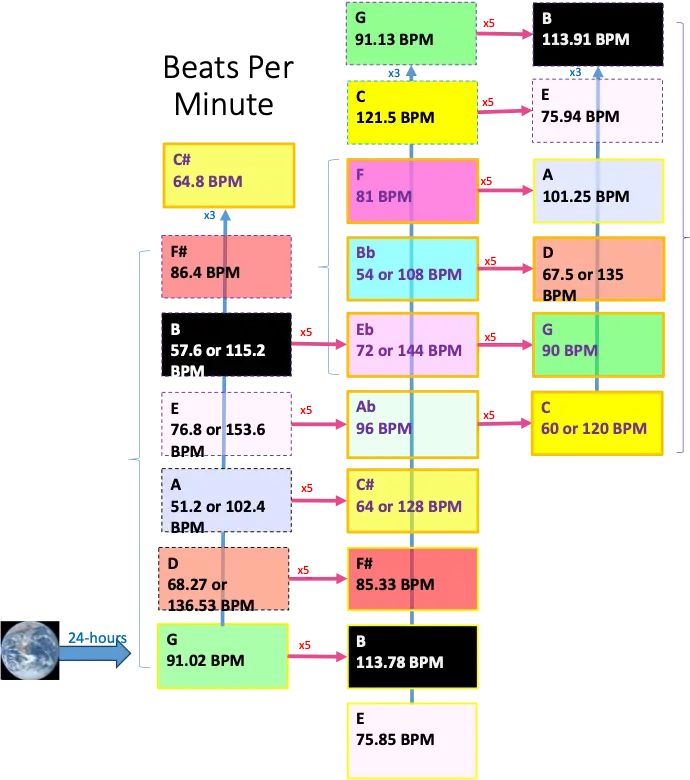
For example, one beat every 24-hours, when doubled and doubled repeatedly to a beat people can dance to becomes 91.02 BPM. And the other frequencies in this chart are 3rd and 5th harmonics of this fundamental beat – the most powerful harmonics.
In this way, you can set your Beats Per Minute (BPM) to be a very slow version of the frequency of these Natural Frequencies so that when you play a bass note its slow vibration will mesh with your drum rhythm and create a tight, rich, incredibly resonant matrix of energy that will tie you and your audience directly to Earth’s electromagnetic harmony.
And you might think that would be scary – but look at what happens to water at these specific frequencies! So, imagine what is happening to your body when you dance in these frequencies!
TUNED TO NATURE
So, I thought it would be good to research which combinations of harmonically tuned notes will yield the fluctuating, wobbling bass effects that mesh with the Beats Per Minute of the track – and basically generate that cymatic effect on the water of your body!
Can we create this harmonic oscillation simply by playing two notes from the harmonic Earth Scale that will together generate a frequency that is the difference between them – and be both aligned with various brainwave frequencies and be in harmony with the Universal principles of electromagnetic harmonics?
Yes we can!
First, these are the frequencies we are using to build the Universal C-major scale (obviously the frequencies halve and double at each octave!)

The G in the lower left corner is precisely the 25th octave of a beat once every 24-hours: (1÷86400 seconds)×2^25 = 388.36148148148 Hz)
This is the Earth’s resonance – which is manifest in many octaves as an electromagnetic resonance humans can feel but not hear.
(By the way, this is not the “Schumann Resonance”, although the Schumann resonance of 7.8 Hz is the 13th harmonic of the E-flat from this Earth-spin scale (0.6 Hz x 13 =7.8 Hz)
HARMONIC PROPAGATION
From our observations, this “Earth G” resonance propagates primarily via 3rd and 5th harmonics.
- All the notes above the “Earth G” in the diagram are 3rd harmonics of each other (the strongest harmonic after the octave)
- And the frequencies we discovered for B-flat and F are 5th harmonics of these notes (in the second column – the 5th harmonic is the next strongest harmonic after the 3rd harmonic))
So, in this way, we have assembled a musical scale entirely from frequencies that are harmonic with the Earth’s electromagnetic resonance! (And probably the resonance of all quantum waves spinning across all the Universe – but we only know for sure about the Earth’s spin resonance.)
SETTING UP THE KEYBOARD
So, now we lay out the piano keyboard (I use Logic, but you could use whatever DAW you like), so that the blue note frequencies from the diagram are the white keys (F, C, G, D, A, E, B) – the 3rd harmonics; and the teal notes (F#, C#, Ab, Eb, Bb) are the black keys – the 5th harmonics.
In this way, when we play a black note with a white note, we’re crossing over from the 5th harmonics to the 3rd harmonics.
SEMI-TONE WOBBLE
And it turns out, with any black note combined with the white note to its right – we get the Bass Wobble oscillation that is harmonic with the key of the song.
For example, if we play the pink F# and G notes together, we get a low octave of that G at 24.27260148 Hz. An oscillation which is the difference between their frequencies:
- G 388.36148148 Hz minus F# 364.0888 Hz = 24.27260148 Hz
- 24.27260148 Hz is a sub-octave of the G: 24.27260148 x 16 = 388.36148148
As I’ve shown above with color coding, every combination of a black note with the white note to its right creates an oscillation that is in harmony with the BPM of the music track!
That’s a nice coincidence – and now, in effect, you have 5 black buttons on your keyboard which can be called on at-will to generate harmonic BPM bass wobble oscillations in-tune with the Earth!
BEATS PER MINUTE IN TIME WITH THE EARTH
How do we know? Well, here are the BPMs again for each of the frequencies in the Natural Frequency harmonic scale:

And here are the corresponding ultra-low frequencies from which can generate brainwave entrainment:

So now, simply by playing a black note and a white note together, you create a Bass Wobble at a binaural frequency lower than any note on the keyboard, below human hearing (slower than 20 Hz) – and therefore, from just a normal keyboard, you can generate bass combinations that are say 2 or 3 beats per second – extremely low octaves of these frequencies.
And these wobbles can correspond to different brain-wave states – Alpha, Gamma, Delta, Theta.
Just play the black/white combinations in whatever octave you want to get the speed of the oscillation that gives you the rhythmic feel you want.
e.g. 24.27260148 / 2 = 12.136 Hz, etc.
That G bass oscillation (12.136 Hz x 60 seconds / 8 = 91.02 BPM):- the BPM corresponding to the Earth’s 24-hour spin, as shown in the lower left of the diagram above!
This is true of each of the colored note pairs below: The black note and the white note to its right will together yield an oscillation that is a slow, rhythmic sub-octave of that white note and the harmonics of the Earth.
This is not true of Tempered tunings because the harmonics are by definition broken in a Tempered scale. Today’s “standard” (broken, nasty) musical tuning was introduced in the 1930s and, no matter what you do with it, always has a nasty, Nazi flavor to it – at least that’s how I hear it.
BPMs FOR ALL KEYS
This works in any key: Here I have transposed the Natural Frequencies of Eb-major so that the Eb is where the C usually is. And the black/white semi-tone trick still works!

You can build scales for all keys of Earth’s electromagnetic resonance, and you could build wobble bass that works for all of those BPMs.
And again, the black/white note combinations yield binaural oscillations which correspond to the harmonic BPMs of that E-flat key.
SUMMARY
So, if you want to create rich resonant music with bass wobble which meshes precisely with the harmonic Beats Per Minute in time with the Earth’s Natural Frequencies ! – then, after you’ve tuned this way, all you need to do is play a black note and the white note to its right.
May we all wobble into alignment with Nature’s resonant beauty!