

Vibration makes things – and using things like salt, sand or water, we can see those underlying vibrations.
Quanta on the Edge of Time
Different patterns emerge at different frequencies. We’ve been taught to think of reality as “particles” – or at least quanta, or packets of energy.
Guess what? Specific frequencies have specific wavelengths. Those wavelengths could be mistaken for “packets” of energy – pulses of energy twanging the aether.
Why the phenomena of cymatics is not taught to every 5 year old beats me. But, good news! – they do teach this in Anthroposphical schools – Rudolph Steiner’s legacy – if you have one near you.
music of the spheres
In the 1970s TV series, The Ascent of Man – episode 4, “Music of the Spheres”, Jacob Bronowski demonstrates the physics of musical harmony advanced by Pythagoras and his disciples on the Greek island of Samos; showing how a stretched string yields musical harmonics when touched at whole-number divisions of its length.
My guitar teacher showed me harmonics when I was 5 – touching the little finger to the string, right above the 12th fret – to yield a singing, pure tone, one octave higher.
Some say Pythagoras learned this from time in Egypt: – that harmonics at whole-number divisions of a string create still nodes – like strings within the string – overtones – notes within notes.
The elements of melody are encompassed in each vibrating string. The octave, 3rd, 5th, 7th, 9th, 11th harmonic – everything needed to make music is there in one string. One fundamental creates them all. In the beginning was the vibration. So, maybe there’s a “string” – like the “monochord” of yore – which sets the vibration for the whole universe.

harmonic series
One Monday morning in early 1994 – being between jobs – I went to the trouble of playing harmonics at measured distances along the guitar string, and figuring out what note was generated where. You can try this too:
- Touching the string at the mid-point gives us an octave because the string is now vibrating in two parts, each at twice the original rate
- A finger held at one third of the string’s length creates three equal divisions of the string, vibrating three times faster than the original – the note “so” in do-re-mi-fa-so
- Touching at a quarter of the length generates an octave above the octave
- At a fifth of the string’s length, the harmonic gives the third note in the scale (do-re-mi)
- etc.

Image Source: https://en.wikipedia.org/wiki/Harmonic
Here are all the harmonic notes – generated by playing harmonics on a B-flat string – starting 1/2 way along the string, going to a 9th division of the string:
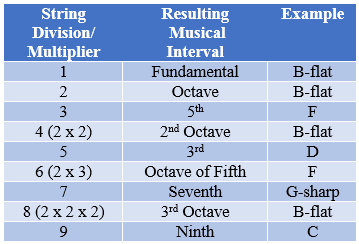
And, in sequence:
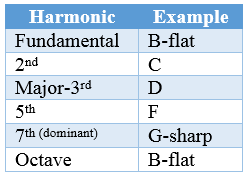
The harmonics described above are all “over-tones” – vibrating faster than the original note. As players of stringed instrument know, the easiest harmonics to play are:
- Octaves (at a point half-way, or a quarter way, down the length of the string)
- Fifths (at a point a third of the way down the string)
- Thirds (a fifth of the way along the string).
- “Seventh” harmonics (played at one 7th the string length) are more difficult to play – and after that it becomes difficult to get the harmonic to ring at all. They’re just not so prevalent in the fundamental note. (Unless you’re Eddie Van Halen with a Marshall stack playing micro-harmonics).
Modern “fast Fourier” spectral analysis of sound bears this out – that the more esoteric harmonics are fainter and less resonant. Here’s a diagram of the relative amplitude of harmonics generated by a violin:

[Image source: University of New South Wales Physics Department]
- Four Octaves of the fundamental note (G)
- Two Fifth intervals (D)
- One Major 3rd interval (B)
- One 7th (F)
- And some un-marked notes which appear to be another Major 3rd (B), another fifth (D), another Octave (G) and an 11th harmonic (C-sharp), plus some micro-tonics
… all resonating within the one string being played – the G. And the relative loudness of these harmonics is in fact what differentiates the sound of a saxophone, for example, from a trumpet or a violin:
THE ROLLIng Stones!
What’s this bunch of reprobates doing in our voyage to the center of music?!
It turns out that the 5-string “open-G” tuning taught to Stones guitarist Keith Richards by Ry Cooder in 1968 exactly follows the natural harmonic-series. In bold are the harmonics to which open 5-string guitar is tuned:
- Fundamental
- 5. Octave
- 4. Fifth interval
- 3. Octave
- 2. Major Third interval
- 1. Fifth interval
- Seventh harmonic
- 9th harmonic
It’s as though the five strings are tuned intentionally to ring out the natural harmonics that are present within the first string. 5 strings resonating as one:
- 5. G – fundamental
- 4. D – third-harmonic, (AKA “Perfect 5th” interval)
- 3. G – 2nd harmonic (AKA octave)
- 2. B – 5th harmonic (AKA “major-3rd” interval)
- 1. D – 6th harmonic, (AKA octave of “Perfect 5th” interval)
With a capo placed across any fret you like, the fundamental note and the resonance of the entire instrument can be changed – to suit the inspiration of the song – and then fretting specific notes allows the harmony of the vibration to be explored as rhythm and melody.
Brown Sugar, Tumbling Dice, Start Me Up – many of the hits from 1968 to the present day were written and recorded in this “open-G” tuning.
Keith Richards himself remarked in notes at the Exhibitionism exhibit that he is fascinated with “how one string makes another vibrate” – called sympathetic vibration.
Keith himself has remarked that open-tuning is like a sitar – with a sort of drone note ringing in the background. The enduring popularity of the Rolling Stones’ music, when Keith (and Mick!) have constructed songs around this approach, shows that these open tunings and the way of playing them, really “strikes a chord” with many people.
This very insight opened up a realm of possibilities for me – in terms of playing chords while playing notes that are harmonically aligned to the fundamental resonance of the open notes. This is the fundamental nature of music. And, if we could find the right chords, perhaps, this could be the fundamental music of nature!
the “modes”
You get a different emotional feeling in a piece of music depending on which note of the scale it starts on – which, by the way, is usually the one it ends on – that’s how you know you’re back to the song’s point of rest – its “point of view”.
And the reason that certain music sounds happy or sad has to do with which note of the harmonic series that starting note is. Depending on whether you start your piece of music on the first harmonic, the second harmonic, the fifth harmonic, etc – you get a very different feeling in the music.
If you have a piano handy, try playing only the white notes:
- Starting at a C – you get a nice, jolly, major scale – found in many Christmas carols
- Now, play the same white notes starting at an A – gives you a sad, minor scale
Same notes – different starting note – different feeling.
This is not just because certain notes carry an emotional weight necessarily (although I believe they do) – but because the intervals – the gaps between the notes as you climb the scale from your starting note – are spaced differently depending on the starting point.
- If you start a melody on the second note of the harmonic series (the A-note, if you’re still playing white notes on the piano), it forces the third note in the scale to be just a semitone above the second note – and that’s where the sound we recognize as sad comes from. It seems to be a common, psycho-acoustic reaction across all cultures. A scale that starts with the second note of the harmonic series is known as a “Minor” scale (or Aeolian mode).
- If you start with the fourth harmonic (the C in our white-note example, above), you get a more optimistic, “major” mode. The interval between the second and third note is a whole tone, instead of a semi-tone. And the interval between the 7th and octave is a semi-tone – it too has a wider step. It sounds happy, complete, robust, confident, healthy – if a little proud. This is the “Major” (or Ionian) mode.
There is a mode name for each of the seven starting positions in the harmonic series. For example:
- If you start with the first note of the harmonic series, it’s called Mixolydian mode. It sounds happy (major third), though a little poignant (minor 7th). But, being as this mixolydian “mode” is actually the natural harmonic series itself, the music played in this mode matches the “personality” of the universe itself, in my view: “happy” yet “poignant”
- Aeolian mode, (the familiar western “Minor” key – just doesn’t have the energy for a full major third, it also has a minor seventh. It has humility (minor 7th) but generally lacks “get-up-and-go”. After a while, it’s quite exhausting, like a friend who comes over and moans about their life for a few hours. It’s a relief when it’s over
- Major (Ionian mode) sounds pompous and over-blown after a while. One needs a little humility (a minor 7th, perhaps) as the antidote.
- Phrygian mode starts at the 6th note of the harmonic series – it is the basis for Flamenco – full of fire and passion, but ultimately, tragic. It has a minor third, a minor sixth, a minor 7th. Everything is “minored out”.
But Western “classical” music, for whatever reason, only talks about Major (Ionian) and Minor (Aeolian). You don’t see a piece by Beethoven called “Sympony Number 26 in G-Phrygian” – even though it may be – it will likely be called “G-minor”. And you’re more likely to see a piece in Ab-Major than you are in Ab-Lydian – even though that may really be what’s going on. Our culture tends to simplify and obfuscate.
Mixolydian mode is generally found in folk and country music. Because it is the only mode that reflects the natural harmonic series by including a major-third and a minor, “dominant” 7th – Mixolydian mode is the “natural” mode which describes the harmonics emanating from its fundamental note – so it is the mode we will be looking to to reflect the harmonics of our fundamental, universal tone..
Cymatic Frequencies
As it turns out, the video above includes quite a few frequencies that are close to the frequencies I detected of the Earth’s resonance. We have to remember though that when using a sheet of metal, we are getting information about the resonance of the sheet, as much as the nature of that frequency:

But detecting the frequencies directly as electromagnetic interference gives us a reading of the Aether itself. Amazingly, these frequencies in water are also the most astonishing versions of “cymatics” you are likely to see.